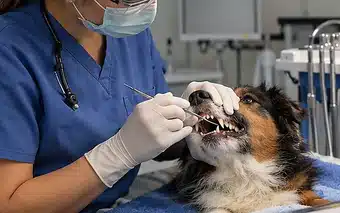
A newly damaged tooth
Ask whether the event meets the accident definition and whether the proposed extraction or repair is an eligible treatment.

Follow three different dental events through the benefit that could pay for each.
Use these checkpoints to frame the literal question before reading the full guide.
Pet dental insurance options depend on why the dental work is needed. Accidental tooth injury, dental illness and preventive cleaning may use different insurance provisions or routine-care benefits. Compare the event first, then the individual invoice lines and applicable allowance. A service plan or wellness allowance should not be mistaken for broad insurance against dental disease.
The sections below show how to verify the answer and what can change it.
Ask whether the event meets the accident definition and whether the proposed extraction or repair is an eligible treatment.
Find the dental-illness provision and review prior signs, records, exclusions and any sublimit before calculating payment.
Look for the routine-care schedule or service contract; do not start with an accident claim formula.
These scenarios are hypothetical and do not diagnose your pet. The veterinarian determines the reason for care and the appropriate treatment. AAHA’s current dental guidance explains why anesthesia and imaging are important parts of thorough veterinary dentistry. Insurance classification still depends on the contract, so request an itemized estimate that distinguishes examination, imaging, anesthesia, cleaning and treatment.
| Service | Policy / add-on type | Allowance or limit to identify | Evidence required |
|---|---|---|---|
| Repair after accidental damage | Accident coverage with dental wording | Main payment limit or a dental restriction | Event account, diagnosis and allowed treatment |
| Treatment of dental illness | Illness benefit or dental rider | Dental sublimit and remaining main limit | Eligibility history and procedure terms |
| Routine cleaning | Preventive benefit or wellness arrangement | Scheduled cleaning amount and aggregate annual balance | Service schedule and itemized charge |
| Oral examination | Exam provision for the qualifying event | Included amount, separate cap or exclusion | Selected exam option and invoice |
| Radiographs and anesthesia | Related-expense wording or cleaning schedule | Shared allowance versus independently eligible expense | Insurer’s component-by-component response |
| Home dental supplies | Routine schedule if specifically listed | Named allowance, otherwise unresolved | Exact eligible-service list |
Official examples demonstrate the split without establishing one best choice. Embrace describes dental illness and routine care separately. A Healthy Paws sample contains an accidental-tooth exception within a dental exclusion. Those examples do not answer every procedure or state; use the current policy and endorsements for the option you are actually considering.
Keep policy terms, deductible, reimbursement and limits beside the quote so the comparison stays consistent.
Imagine a $600 cleaning estimate and a routine-care option costing $180 annually. Its invented schedule allows $100 for cleaning. If no other benefit is used, the owner pays $180 + $600 − $100 = $680 overall. Without that option, this isolated expense would be $600. Other benefits can change the calculation, but only if eligible, used and within all limits. Unused allowance is not cash savings.
Now imagine a different eligible dental illness with $1,400 in eligible charges. Under an invented policy with a remaining $250 deductible, 80% reimbursement after deductible and a $1,000 dental payment cap, the provisional payment is ($1,400 − $250) × 80% = $920, below that cap. The owner retains $480 plus premiums. This assumes the event qualifies and the cap limits payment after cost-sharing; verify the actual contract’s ordering.
Do not assume that an extraction makes every cleaning charge part of an illness claim, or that an allowance for cleaning automatically includes all anesthesia and radiography fees. Ask the insurer to map each estimated line to the benefit and explain whether the limit is shared. Keep the veterinarian’s itemization intact rather than asking the practice to rename services to fit coverage.
No prices or allowances in the worked examples describe an available product. Current quotes and state-specific terms were not compared across the market, so this guide does not rank providers. Its purpose is to keep unlike dental benefits from being compared as though they pay the same bill.
Do not assume so. Check its named services and limits separately from dental-illness insurance.
Discuss appropriate care with the veterinarian. Insurance reimbursement is not a clinical recommendation.
Keep the policy terms beside the price, then continue to rates when the comparison is clear.